
What Does It Take for Nonprofit Housing to Go Green?
A small cohort of organizations has been retrofitting nonprofit housing in Southwestern Ontario with great results. Over the course of two years, 777 homes were retrofitted, reducing yearly emissions by 1,890 tonnes of CO2e, and preparing nearly 100 prospective apprentices with training in green skills.
What makes the achievement remarkable isn’t just the sheer number of homes retrofitted but it’s that the three organizations behind them, London Environmental Network (LEN), Indwell, and Building Up, who have recognized key barriers to greener housing and tackled each one with different solutions, all working in their own way.
The problem
Buildings account for a third of Canada’s greenhouse gas emissions, emitting 81.4 Mt CO₂ in 20241. These emissions remain extremely difficult to abate. The older housing stock is among the worst offenders, often leaky, inefficient, and expensive to heat. Retrofitting these buildings is one of the most direct climate actions any community can take. Every upgraded furnace, insulated wall, and solar panel cuts emissions year after year while also improving tenant experience and saves on operating costs along the way.
Unfortunately, nonprofit and affordable housing providers face the steepest barriers to getting this done. Operating budgets are stretched thin, and capital, expertise, and skilled labour are often out of reach. There’s a human risk too; retrofit projects done carelessly can disrupt or displace vulnerable tenants.
Three barriers, three solutions
Addressing these challenges requires more than a single solution. It takes new approaches to how retrofits are delivered, how housing providers are supported along the way, and who is equipped to do the work.
Innovation and speed: Trim Tab, a start-up energy contractor, partnered with community housing provider, Indwell, to test a less disruptive approach to deep energy retrofits. By completing the work during brief and rare tenant turnover periods, the team replaced fossil fuel heating systems with electric alternatives alongside routine renovations. At the Woodstock pilot, emissions fell from 3.9 to 0.9 tonnes/year per unit, a whopping 77% reduction, while eliminating tenants’ natural gas bills. What’s more, they found ways to speed up the retrofit process while maintaining high standards. By the third unit, the full retrofit was completed within only a one-month turnover window.
Building capacity: Through its Nonprofit Resiliency Project, London Environmental Network (LEN) supports nonprofits managing multi-unit residential buildings for equity-deserving communities, offering individual support including carbon accounting and sustainability action planning. This helps capacity-strapped organizations, offering help exactly where they need it most. Through this model, LEN has implemented more than 30 sustainability projects to date. Its recent tenant-centered deep retrofit, complete with 20 kW of new solar capacity, was one of their most exciting to date.
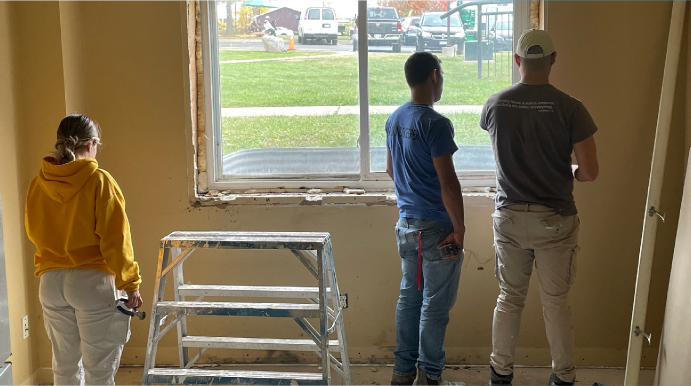
The workforce: Green retrofits need skilled trades, and the sector is short of them, so Building Up turned the retrofits themselves into a training ground. Its paid pre-apprenticeship program pairs classroom learning with real insulation and draft-proofing jobs, opening doors to the trades for people facing barriers to employment. The results speak well. In their green insulation work alone, 96 trainees gained green skills and two rose into leadership roles, managing crews of their own. Those trainees retrofitted roughly 750 homes, including some 250 units in community housing.
Taken together, the results of these three organizations add up to something no single one could achieve alone:
- 777 homes retrofitted, not just for climate but also for tenant comfort, safety, and security
- 1,890 tonnes CO₂/year in direct emissions reductions, equivalent to taking roughly 400 cars off the road permanently, a huge win for climate
- 20 kW of renewable energy capacity installed, enough solar to power a multi-tenant building
The Peter Gilgan Foundation is proud to support these organizations as they demonstrate what is possible for nonprofit housing: a climate-secure future, more comfortable homes, and a stronger sector equipped to deliver retrofits on a greater scale in the years ahead.
References
1Government of Canada’s Greenhouse gas emissions
Resources